Written by Peter Regalado, Operations Manager · Reviewed by Mason Pastorello, Managing Director · Last reviewed: July 2026
The difference between ACV and RCV comes down to depreciation. Actual cash value (ACV) pays what your roof is worth today, after subtracting for age and wear, while replacement cost value (RCV) pays what it costs to replace the roof new — often reimbursing the depreciated portion after the work is done. For a homeowner, that difference can mean thousands of dollars out of pocket, so understanding which one your policy uses is one of the most important things you can know before a claim. This article explains both in plain English — how depreciation works, and why the distinction matters so much in a hail-prone state like Colorado. It's general information, not advice about your specific policy.
What actual cash value (ACV) means
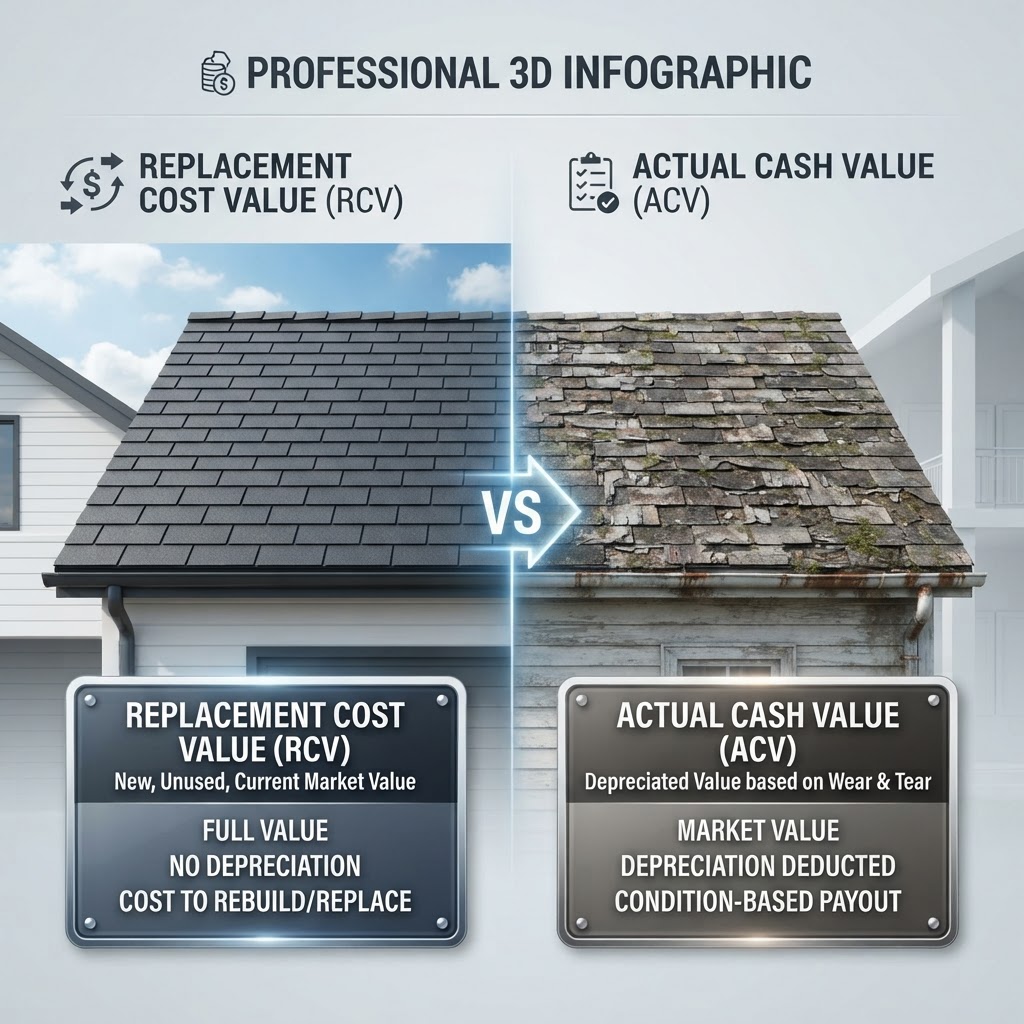
ACV is the depreciated value of your roof. Insurers calculate it by taking the replacement cost and subtracting depreciation for the roof's age and condition. The idea is that a fifteen-year-old roof isn't worth the same as a brand-new one, so an ACV settlement reflects the used value of what was damaged. In practice, this means an ACV payment on an older roof can be substantially less than the cost to actually replace it — and you cover the difference. ACV policies, or ACV treatment of older roofs, are common enough that homeowners are often surprised at claim time.
What replacement cost value (RCV) means
RCV pays the cost to replace your roof with new materials of like kind and quality, without the permanent depreciation deduction. RCV is more generous, but it usually comes with a condition: it's typically paid in two stages. First, the insurer pays the ACV amount up front. Then, after the work is completed and you or your contractor submit proof, you can recover the withheld depreciation, up to your policy limits and minus your deductible. This is called recoverable depreciation. The practical effect is that with an RCV policy you can end up covering much less out of pocket than with ACV — but you generally have to complete the work to collect the full amount.
How depreciation actually works
Depreciation is the reduction in value from age and wear, and it's the hinge the whole ACV-versus-RCV distinction turns on. A roof loses value over its life; on paper, a roof partway through its expected lifespan has lost a corresponding share of its value. With ACV, that depreciation is subtracted and gone. With RCV, that depreciation is withheld initially but recoverable once you complete the replacement. Recoverable versus non-recoverable depreciation is a key phrase to know: recoverable means you can get it back by doing the work; non-recoverable means you can't.
What factors affect how much depreciation applies
Since depreciation is the whole game with ACV versus RCV, it helps to know what drives it:
- Roof age — the biggest factor. The older the roof, the more depreciation, and the larger the gap between ACV and RCV.
- Expected lifespan of the material — a material with a longer rated life depreciates more slowly on paper than a shorter-lived one.
- Condition — a roof that was already worn or poorly maintained may be depreciated more heavily than its age alone suggests.
- The insurer's own depreciation schedule — different carriers apply depreciation differently, and some use accelerated schedules for roofs specifically.
Because these factors compound, an older roof on an ACV basis can yield a settlement far below replacement cost. Knowing this in advance lets you plan rather than be blindsided at claim time — another reason to understand your policy's roof terms before a storm rather than after.
Which one applies to you — check your policy
Whether your policy pays ACV or RCV, and how it treats your roof specifically, is written in your policy. Some policies are RCV across the board. Some are ACV. Many are RCV in general but shift older roofs to ACV once they pass a certain age, or apply special roof schedules that increase depreciation as the roof ages. Because roofs are a common and expensive claim, insurers pay particular attention to roof age in their terms. The only reliable way to know your situation is to read your policy and ask your insurer directly two simple questions: does my policy pay ACV or RCV on my roof, and does my roof's age change that?
A simple example to make it concrete
Imagine two identical homes hit by the same hailstorm, both needing a full roof replacement. The first has an RCV policy. The insurer pays the depreciated amount up front, the homeowner has the roof replaced, submits proof, and recovers the withheld depreciation — ending up out of pocket mainly for the deductible. The second has an ACV policy, or an older roof shifted to ACV. The insurer pays only the depreciated value, and the homeowner covers the rest of the replacement cost themselves. Same storm, same roof, very different out-of-pocket cost — driven entirely by ACV versus RCV. This is why the distinction isn't academic; it's often the single biggest factor in what a hail claim costs you.
How to recover depreciation on an RCV policy
If you have an RCV policy, recovering the withheld depreciation follows a general sequence worth understanding:
- You file the claim, and the insurer determines the covered scope and issues an initial payment — usually the ACV amount, minus your deductible.
- You have the work completed by a contractor.
- You or your contractor submit documentation that the work was done, often including invoices and sometimes photos.
- The insurer releases the recoverable depreciation, up to policy limits.
The key practical point is that with most RCV policies, you generally have to actually complete the replacement to collect the full amount. If you take the initial ACV payment and don't do the work, you typically don't receive the withheld depreciation. There may also be time limits for completing the work and submitting documentation, so check your policy and confirm any deadlines with your insurer. This is one reason working with a contractor who documents thoroughly and completes the job properly matters for the financial outcome, not just the roof.
Why this matters so much in Colorado
Colorado's frequent hail means roof claims are common, and roofs here often take repeated storm damage over their lives. That makes the ACV-versus-RCV question especially consequential: a homeowner in the hail belt is more likely to face a roof claim, and more likely to feel the difference between the two. It's genuinely worth knowing which your policy uses before a storm, not after. If your roof is aging, it's also worth understanding how your policy's treatment of roof age might shift you toward ACV over time.
What a contractor can and can't do here
A roofing contractor can document your damage, provide a detailed replacement scope and estimate, and — if you have an RCV policy — complete the work that lets you recover withheld depreciation. What a contractor can't do is change whether your policy is ACV or RCV, or decide how much depreciation applies; those are set by your policy and your insurer. Be cautious of anyone who implies they can get you more than your policy provides, or who guarantees a particular settlement. Our role is honest documentation and quality work, not promises about your carrier's decisions.
Diagram comparing actual cash value and replacement cost value on a roof claim
Frequently Asked Questions
- Licensed & insured — documentation available on request
- Free, documented roof inspections
- Real emergency service available
- 5-year workmanship warranty (manufacturer warranties vary by product)
- 30 years of construction experience
- Serving Denver, Adams, Arapahoe, Douglas, Jefferson, and El Paso counties
Promise Keepers Restoration
9615 E. County Line Rd, Ste. B-477, Centennial, CO 80112
Hours: Mon–Sat 8:00 AM–5:00 PM