Most Colorado roofs get replaced for one of three reasons: hail or wind damage, age, or a pattern of failures that repairs can no longer keep up with. Before any of those becomes a replacement, it should be confirmed by an inspection — not assumed. We start every job on the roof, not with a quote.
A roof replacement is one of the larger investments you'll make in your home, so this page explains how to know when you actually need one, what the process looks like from first call to final cleanup, and what genuinely drives the cost. If a repair can solve your problem, we'll tell you that — and we'd rather earn your trust now than sell you a roof you didn't need.
When a roof replacement makes sense
Replacement usually becomes the right call when damage is widespread rather than isolated, when the roof is near the end of its service life, or when repeated repairs are no longer cost-effective. Common triggers on the Front Range:
- Storm damage across a large portion of the roof — hail bruising, mat fracture, or wind-lifted and missing shingles affecting multiple slopes rather than one corner.
- Age — asphalt shingle roofs in Colorado's intense UV and freeze-thaw cycles often show real wear before their rated lifespan, especially on south- and west-facing slopes.
- Granule loss, curling, or cracking across many slopes — a sign the shingles themselves are failing, not just one damaged area.
- Active leaks with underlying deck or underlayment deterioration — when water has already gotten past the surface and into the structure.
- A failed roof on a home you're selling or insuring — where a patch won't satisfy a buyer's inspector or a carrier's underwriting.
None of these should be diagnosed from the ground or from a photo alone. That's what the inspection is for.
Signs you may need a new roof
There are warning signs a homeowner can spot without climbing up: shingles in the gutters or scattered in the yard after a storm, daylight or water stains visible in the attic, sagging areas in the roofline, granules washing out of downspouts, and a roof that's simply old and has weathered repeated hail seasons. Any one of these is a reason to get on the schedule — but not automatic proof you need a full replacement. Only an inspection settles that.
Our inspection process
Every replacement starts with a free, documented inspection. We examine the field of the roof and, just as importantly, the details that actually fail first: flashings, valleys, penetrations, and the condition of soft metals — vents, gutters, and downspouts — that often reveal hail impact before the shingles do. We photograph what we find so you can see the roof the way we see it, and so there's a clear record if an insurance claim is involved.
If the damage turns out to be repairable, we'll say so. A replacement recommendation should always be backed by evidence you can look at yourself, not by a sales script.
What's actually involved in a replacement
A quality replacement is more than tearing off old shingles and stapling on new ones. Done correctly, it involves:
- Tear-off of the existing roofing down to the decking (in most cases), so nothing is hidden underneath.
- Deck inspection and repair — any soft, rotted, or delaminated sheathing gets replaced before anything goes over it.
- Underlayment and ice-and-water shield — the water-resistant layers, with extra attention to eaves and valleys where Colorado's freeze-thaw and ice dams push water backward.
- Flashing — new or properly reused metal at chimneys, walls, valleys, and penetrations, where most future leaks would otherwise begin.
- Ventilation — confirming intake and exhaust are balanced, because a poorly ventilated attic cooks a new roof from below.
- Shingle or panel installation to manufacturer specification.
- Cleanup, including a magnetic sweep for nails.
When a bid comes in unusually low, it's often because one of these steps — underlayment quality, flashing, decking allowance, or ventilation — is being quietly skipped. Those are exactly the corners that determine whether a roof lasts.
Replacement options and materials
We install standard architectural asphalt shingles, impact-resistant Class 4 shingles (worth serious consideration in Colorado's hail belt), and metal roofing. We install products from manufacturers including Owens Corning, Malarkey, GAF, and CertainTeed, and we'll install the product you prefer.
One honest note: on residential work we install these brands but don't hold manufacturer "certified contractor" designations. Some companies present themselves as manufacturer-certified when they aren't — we'd rather be straight about it.
| Option | Best for | Tradeoff |
|---|---|---|
| Architectural asphalt | Budget-conscious replacement | Standard hail resistance |
| Class 4 impact-resistant | Hail-prone Front Range homes | Higher upfront cost; possible insurance premium discount (varies by carrier) |
| Metal | Longevity, fire resistance, snow shedding | Higher cost; different aesthetic |
Colorado-specific considerations — Residential Roof Replacement in Colorado
Front Range roofs work hard. High-altitude UV degrades shingles faster than in milder climates. Freeze-thaw cycling stresses flashings and sealants all winter. And the region sees some of the country's most frequent damaging hail. These conditions are exactly why material choice and correct installation of flashing, underlayment, and ventilation matter more here than almost anywhere else.
What affects the cost
We don't publish flat prices, because honest ones don't exist — every roof is different. The real cost drivers are:
- Size and pitch — bigger and steeper roofs take more material and labor.
- Number of existing layers to tear off.
- Material choice — asphalt, Class 4, or metal.
- Decking condition — hidden rot or damage discovered at tear-off.
- Complexity — valleys, dormers, chimneys, skylights, and other penetrations.
- Access — how easily crews and materials reach the roof.
Insurance considerations
If your replacement follows a storm, your homeowners policy may be involved. Our role is to inspect, document the damage, and provide our scope and estimate — the factual information your insurer needs to evaluate the claim.
Common mistakes to avoid
- Replacing on a door-knocker's say-so.
- Choosing the cheapest bid without comparing scope.
- Skipping impact-resistant shingles in a hail zone.
- Ignoring ventilation and flashing.
What to expect working with us
Once you decide to move forward, you get a written scope and a schedule. Most residential replacements are completed in a few days, weather permitting. The work is backed by our 5-year workmanship warranty.
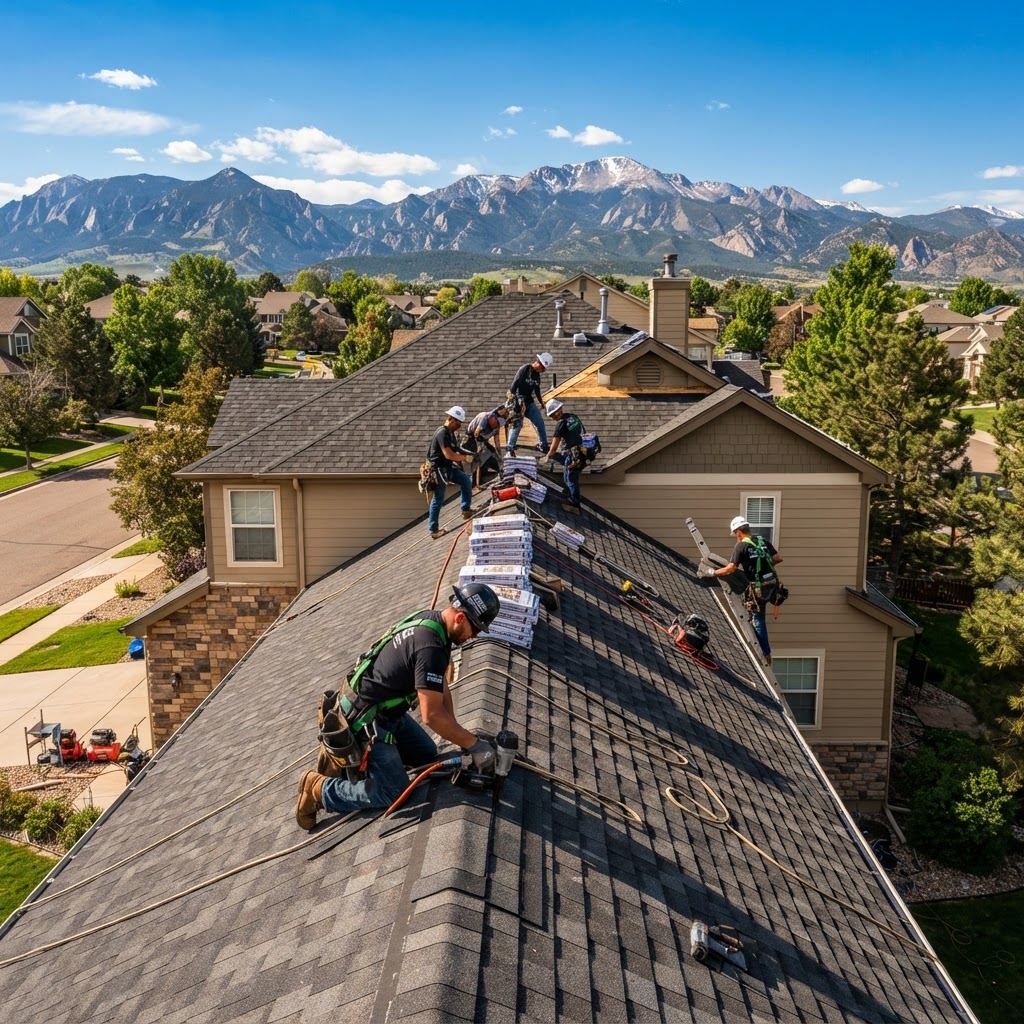
Promise Keepers crew installing a new asphalt roof on a Colorado home
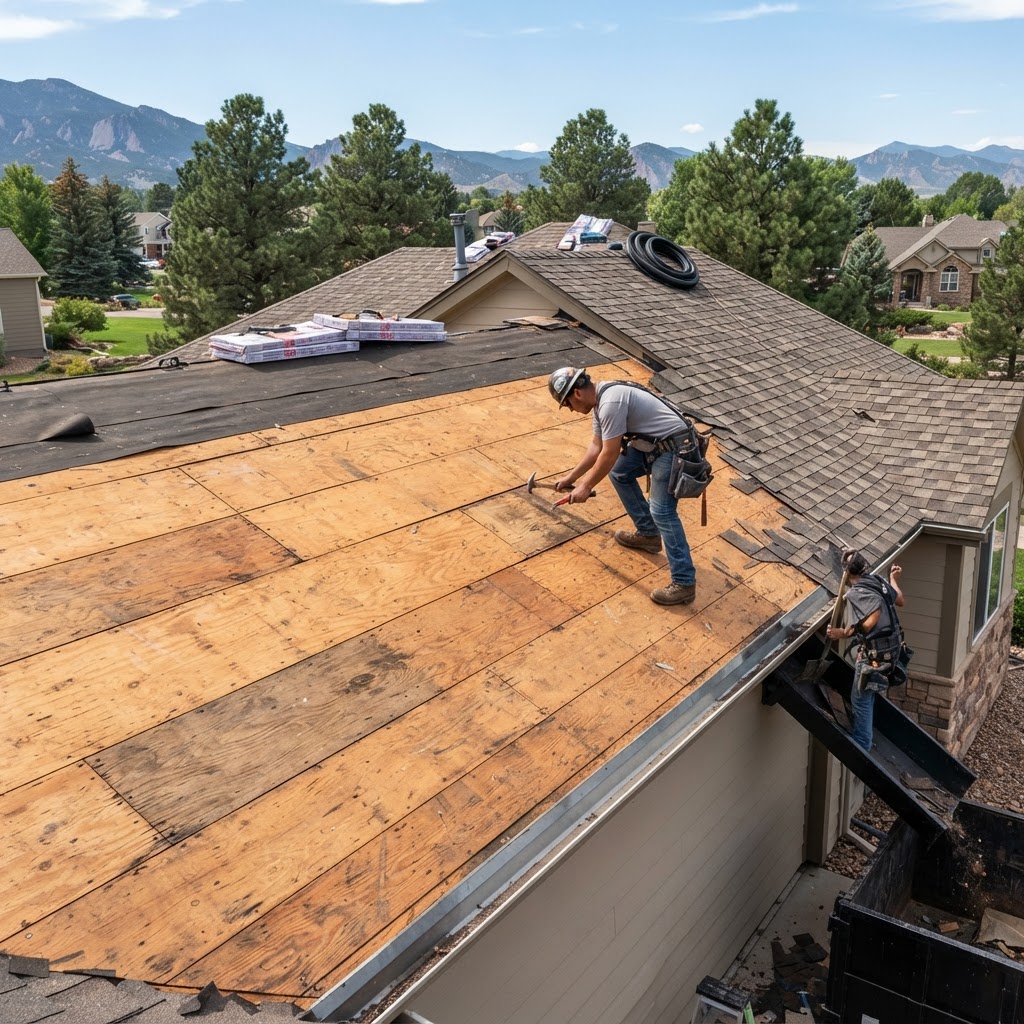
Tear-off revealing decking condition during a Colorado roof replacement.
Frequently Asked Questions
Related Pages
Written by Peter Regalado, Operations Manager · Reviewed by Mason Pastorello, Managing Director · Last reviewed: July 2026
- Licensed & insured — documentation available on request
- Free, documented roof inspections
- Real emergency service available
- 5-year workmanship warranty (manufacturer warranties vary by product)
- 30 years of construction experience
- Serving Denver, Adams, Arapahoe, Douglas, Jefferson, and El Paso counties
Promise Keepers Restoration
9615 E. County Line Rd, Ste. B-477, Centennial, CO 80112
Hours: Mon–Sat 8:00 AM–5:00 PM