Written by Peter Regalado, Operations Manager · Reviewed by Mason Pastorello, Managing Director · Last reviewed: July 2026
Roof matching — also called uniformity — is the question of what happens when storm damage affects only part of your roof, but the replacement shingles won't match the undamaged ones. If an insurer only pays to replace the damaged slope, you can end up with a patchwork roof of mismatched colors, and the matching question is whether and when your policy or state rules require a more uniform result. This is one of the more confusing and contested areas of roof insurance, and the honest answer to most matching questions is: it depends on your specific policy language and the applicable state rules, which can change. This article explains the concept in plain English so you understand the issue and know what to ask. It is general information, not legal or insurance advice — and matching rules are exactly the kind of thing you should confirm with your insurer, the Colorado Division of Insurance, or an attorney rather than rely on a general article for.
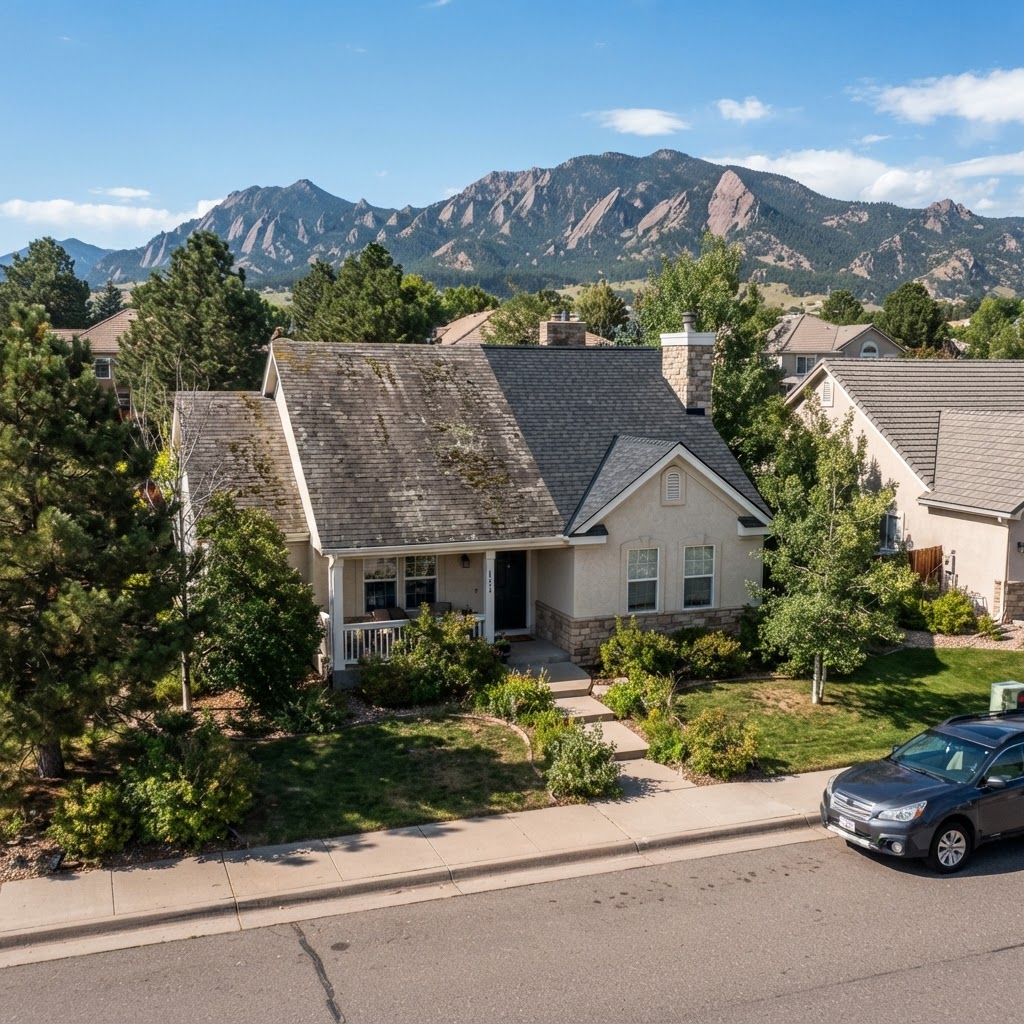
What the matching problem actually is Here's the situation that creates it. Hail or wind damages one or two slopes of your roof, but not the whole thing. The damaged shingles need replacement. But shingles change over time — manufacturers discontinue lines, colors weather and fade, and even the same product made years apart may not match. So replacing only the damaged section can leave you with a roof that's visibly two-toned: new, bright shingles on one slope, aged, faded ones on the others. Matching (or uniformity) addresses whether you're entitled to a result where the roof reasonably matches, rather than a patchwork. It can apply not just to roofs but to siding and other exterior materials, where partial replacement creates a mismatch.
Why shingles stop matching over time It helps to understand why matching is even a problem, since the root of it is practical, not legal. Shingles change in several ways over the years. Manufacturers discontinue product lines, so the exact shingle on your roof may simply no longer be made. Colors get updated or retired, so even a current product from the same maker may not offer your original color. Weathering fades and ages shingles, so that even genuinely identical new shingles look different next to ones that have spent years under Colorado's intense sun. And granule blends and manufacturing can vary slightly between production runs. The combined effect is that a roof more than a few years old often can't be perfectly matched with new material, even when the same brand is still available. On a Colorado roof, high-altitude UV accelerates the fading that drives mismatches, which is part of why the issue comes up here. Knowing this helps you have a realistic conversation: a perfect match on an older roof may not be physically possible, and the discussion is often about what's reasonably achievable.
Why matching is complicated Matching is contested because it sits at the intersection of policy language and state regulation, and both vary. Some policies contain language addressing matching or uniformity of materials, and some don't. Some states have regulations or guidance on how insurers must handle "line of sight" matching and reasonable uniformity, and others leave it largely to policy terms. The result is that two homeowners with similar damage can have different outcomes based on their policy wording and their state's rules. Insurers and policyholders also sometimes disagree about what counts as a reasonable match, and whether a close-but-imperfect match is acceptable. Because of all this, matching is frequently a point of negotiation and occasionally dispute in roof claims.
What "line of sight" means A term you'll encounter in matching discussions is "line of sight." The general idea is that materials within the same line of sight should reasonably match — so that, for example, two adjacent slopes visible together shouldn't obviously clash. How line of sight is interpreted, and whether it's required, depends on policy language and applicable rules. It's a useful concept to understand when discussing your claim, but not a universal guarantee; its application varies.
The Colorado picture — and why you must verify it Colorado homeowners often ask whether Colorado requires matching, and this is precisely where we have to be careful and honest. Whether and how matching applies in Colorado depends on current state regulation and on your specific policy, and these can change over time. We are not going to state a specific rule as settled fact, because doing so would be exactly the kind of unverified legal claim that misleads homeowners. What we can say responsibly is this: matching is a real and recognized issue in roof claims; it may be addressed by your policy language or by applicable Colorado rules; and the reliable way to know your situation is to check your policy and confirm current requirements with your insurer, the Colorado Division of Insurance, or an attorney. If a contractor tells you Colorado guarantees you a fully matched roof — or, conversely, that you have no matching rights — treat both as claims to verify independently rather than accept. This is an area where getting the current authoritative answer matters more than a general rule of thumb.
How matching questions typically come up in a claim In practice, matching becomes an issue when an adjuster's scope covers only the damaged slopes and you're concerned about a mismatch with the rest of the roof. At that point, the questions become: what does my policy say about matching or uniformity, what do current applicable rules provide, and is a reasonable match achievable with available materials? Documentation helps here, as it does throughout a claim — clear evidence of the existing roof and the mismatch that partial replacement would create supports the conversation. As with every part of a claim, the coverage and scope decisions belong to your insurer under your policy and applicable law, not to a contractor.
Practical steps if you're facing a matching issue If partial storm damage has you worried about a mismatched roof, a few practical steps help you navigate it: * Get the existing roof and the damage documented, so there's a clear record of what you have and what a partial replacement would create. * Ask your contractor honestly whether available materials can reasonably match your existing shingles — sometimes they can, sometimes they can't, and you deserve a straight answer. * Read your own policy for any language on matching, uniformity, or line of sight, so you know what your contract says. * Confirm current applicable rules with authoritative sources — your insurer for how they're handling it, and the Colorado Division of Insurance for consumer guidance. * For genuine disputes, the right resources are your insurer's formal processes, the Division of Insurance, or a licensed professional such as an attorney or public adjuster — not a contractor promising to force the outcome. Throughout, keep your documentation organized. As with any claim, being informed and documented puts you in the strongest position, and the coverage decision ultimately rests with your insurer under your policy and applicable law.
When matching may not be an issue It's worth noting that matching isn't always a problem. If your entire roof is damaged and being replaced, there's nothing to mismatch against. If your roof is relatively new, the existing product may still be available and match well. And if the damaged area isn't in the same line of sight as other slopes, a mismatch may be far less noticeable. Matching becomes a live issue mainly when partial replacement of an older roof would create a visible mismatch — a specific situation rather than a universal one. Understanding whether your situation actually raises a matching concern is the first step, before getting into policy and rules.
What a contractor can and can't do with matching A roofing contractor can document your existing roof and the practical matching challenge, assess whether available products can reasonably match your existing shingles, and provide a scope that reflects the work. What a contractor cannot do is decide whether your policy or Colorado rules entitle you to a matched roof, or negotiate that entitlement on your behalf — those are questions for your insurer and, if disputed, for the Division of Insurance or an attorney. Be cautious of anyone who promises to force your insurer to pay for a full roof on matching grounds; that's a claim outcome no contractor can guarantee. Our role is honest documentation and quality work, and pointing you to the right authorities for the questions we can't answer.
Roof showing a color mismatch between newly replaced and older weathered shingles
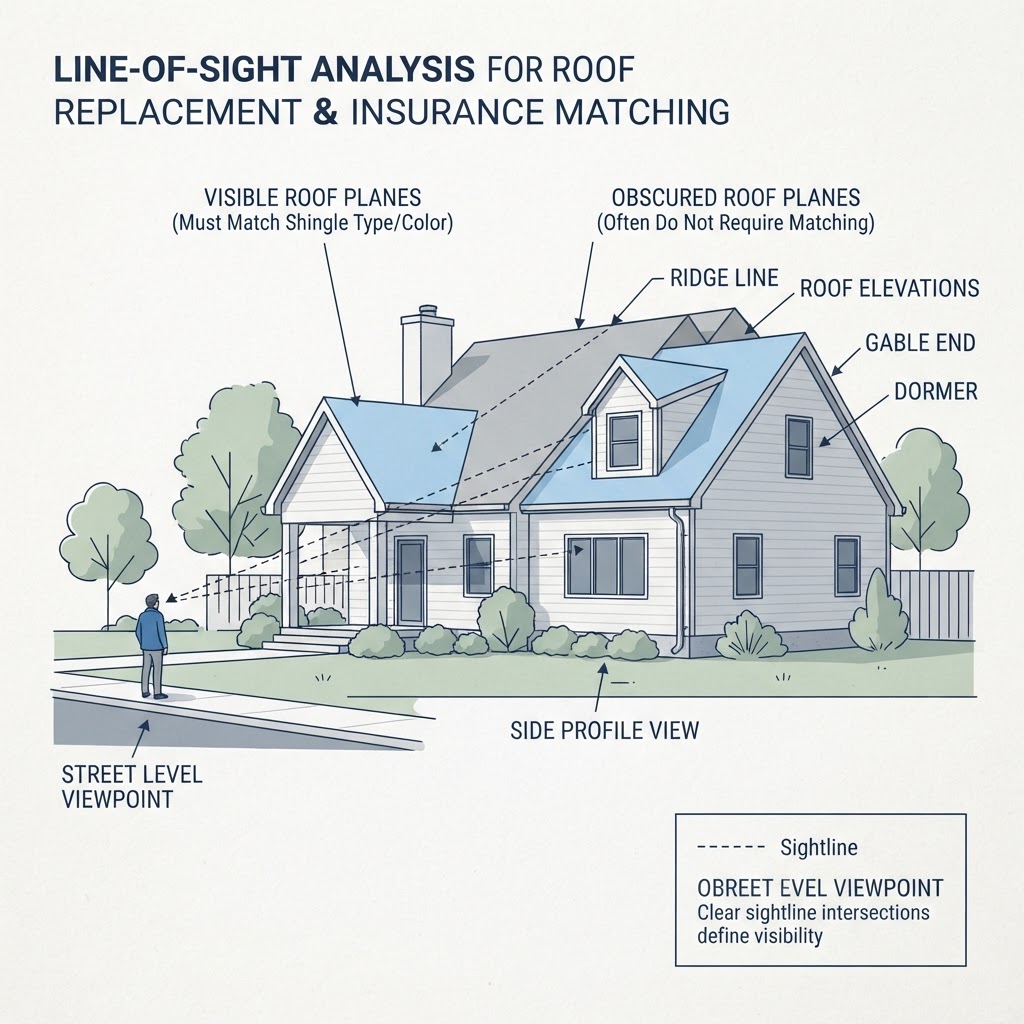
Diagram illustrating line-of-sight matching across roof slopes.
Frequently Asked Questions
- Licensed & insured — documentation available on request
- Free, documented roof inspections
- Real emergency service available
- 5-year workmanship warranty (manufacturer warranties vary by product)
- 30 years of construction experience
- Serving Denver, Adams, Arapahoe, Douglas, Jefferson, and El Paso counties
Promise Keepers Restoration
9615 E. County Line Rd, Ste. B-477, Centennial, CO 80112
Hours: Mon–Sat 8:00 AM–5:00 PM