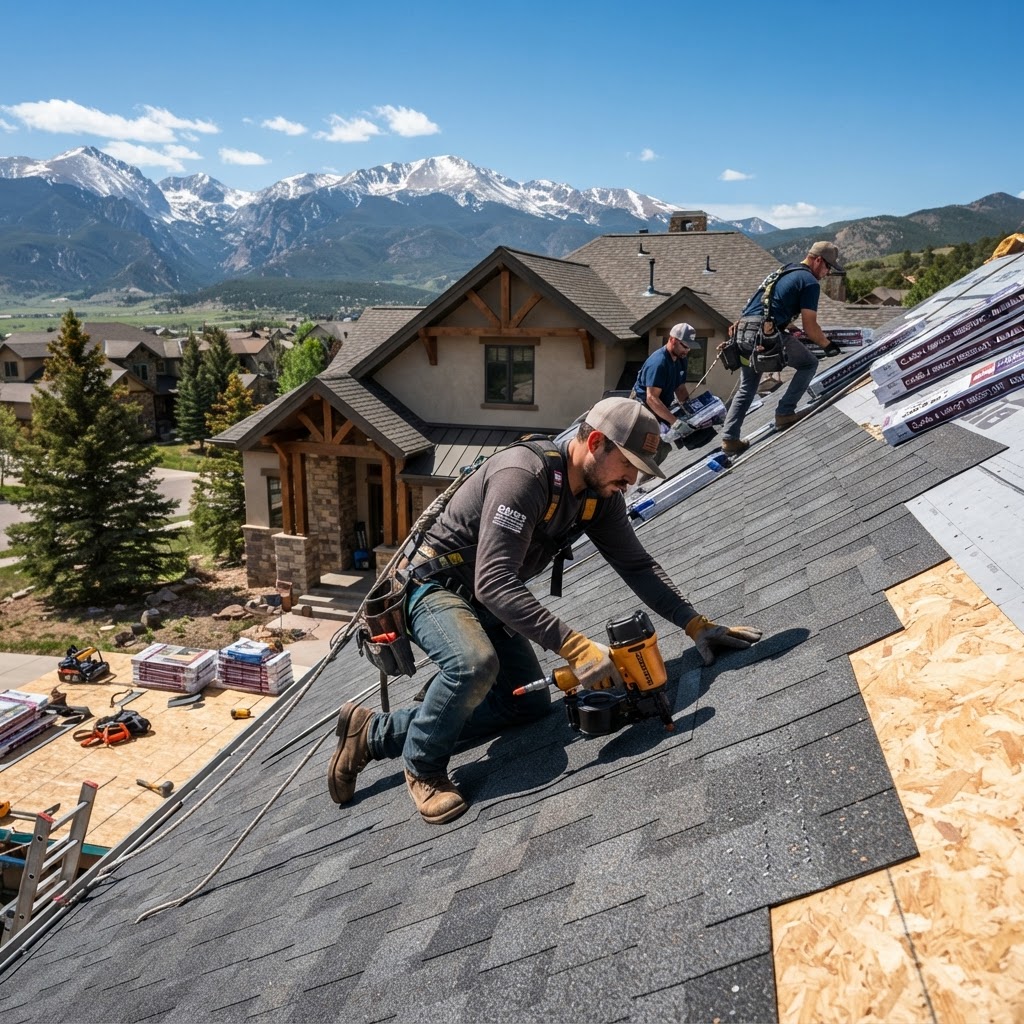
If you own a home along the Front Range, hail isn't a rare event — it's a recurring cost of living here. Class 4 impact-resistant shingles are engineered to stand up to that hail far better than standard asphalt, which is why they come up so often when Colorado homeowners replace a roof. This page explains what "Class 4" actually means, what it does and doesn't do, and how to decide whether the upgrade is worth it for your home.
We install Class 4 shingles from manufacturers including Owens Corning, Malarkey, GAF, and CertainTeed, and we'll install the product you prefer. As with all our residential work, we're experienced installers of these brands but don't hold manufacturer "certified contractor" designations — we'd rather tell you that plainly than imply otherwise.
What "Class 4" actually means
Class 4 is the highest rating in a standardized impact-resistance test used across the roofing industry (UL 2218), in which a steel ball is dropped onto a shingle from a set height to simulate hail impact. A shingle earns a Class 4 rating if it withstands that impact without the mat cracking. Ratings run from Class 1 (least resistant) to Class 4 (most resistant).
It's worth being precise about what the rating measures: impact resistance in a controlled test, not a guarantee against all hail damage. A Class 4 shingle resists cracking and granule loss far better than standard asphalt, but no shingle is truly hailproof. Very large hail can still damage a Class 4 roof. The rating tells you the shingle is built to a higher standard of resilience — which, in a hail belt, is meaningful.
How Class 4 shingles are made
Impact-resistant shingles achieve their rating through construction, not marketing. Depending on the manufacturer, that can mean a modified (rubberized/polymer) asphalt that flexes and absorbs impact instead of fracturing, a reinforcing layer, or a heavier, more robust mat. The result is a shingle that takes a hail strike and springs back rather than bruising or cracking the way standard asphalt does.
The benefits — and the honest tradeoffs
Benefits:
- Better hail resistance. The core reason to choose them in Colorado — fewer bruises, cracks, and granule loss from a given storm.
- Longer real-world life in a hail zone. A roof that resists storm damage tends to reach more of its potential lifespan.
- Possible insurance premium discount. Many Colorado insurers offer a discount for impact-resistant roofing — though this varies by carrier and policy and must be confirmed with yours.
- Fewer claims and disruptions. Less storm damage can mean fewer claims, deductibles, and reroofs over the years you own the home.
Tradeoffs:
- Higher upfront cost than standard architectural asphalt.
- Not hailproof. Large enough hail can still cause damage.
- Discount isn't guaranteed. It depends entirely on your insurer.
- Appearance is similar to standard shingles — this is a performance upgrade, not a dramatic aesthetic one.
Do Class 4 shingles lower your insurance premium?
Often, but not always — and this is where honesty matters. Many insurers operating in Colorado offer a premium discount for impact-resistant roofing, because a more hail-resistant roof means fewer claims for them. But the size of the discount, the eligibility rules, and whether it's offered at all depend entirely on your carrier and policy.
Before counting on a discount, ask your insurer directly: whether they offer an impact-resistant roofing credit, what documentation they require (often a manufacturer certificate showing the Class 4 rating), and how much the discount is. We can provide the product documentation your insurer asks for; the discount itself is between you and your carrier. (We don't quote specific discount percentages — those vary and change.)
When the upgrade makes the most sense
Class 4 shingles are easiest to justify in a few situations:
| Situation | Why Class 4 makes sense |
|---|---|
| You're already replacing the roof | The incremental upgrade cost is small relative to a whole reroof |
| You're in a high-hail area of the Front Range | More storms means more value from impact resistance |
| You plan to stay in the home long-term | More years to recoup the cost through fewer claims and a possible discount |
| You've already been through a hail claim | Reducing future damage is worth more after living through one |
If you're replacing a roof after hail — which is common here — bundling the Class 4 upgrade into that replacement is usually the most cost-effective time to do it.
Class 4 versus standard architectural shingles
Homeowners deciding on a new roof are usually choosing between standard architectural asphalt and a Class 4 upgrade, so it helps to see them side by side:
| Factor | Standard architectural | Class 4 impact-resistant |
|---|---|---|
| Impact resistance | Lower rating; bruises/cracks more easily | Built to absorb impact, resist cracking |
| Upfront cost | Less expensive | More expensive |
| Insurance discount | Typically none | May qualify (depends on carrier) |
| Lifespan in a hail zone | More prone to storm damage | Tends to hold up better |
| Appearance | Similar | Similar |
| Best fit | Budget focus, shorter ownership, lower-hail | Long-term owners, high-hail, post-storm reroofs |
Neither is simply "better" — the right answer depends on how long you'll own the home, how much hail your area sees, your budget, and whether your insurer rewards impact resistance.
What to ask before you decide
A few questions cut through the marketing:
- How long do I plan to stay in this home? The longer the horizon, the more a durable roof pays off.
- Does my insurer offer an impact-resistant discount, and how much? Call and ask before assuming.
- How much more is the Class 4 option on my specific roof? Get it in writing, not as a rough guess.
- Have I had hail damage before? If you've already lived through a claim, reducing the next one has real value.
Colorado-specific considerations — Class 4 Impact-Resistant Shingles in Colorado
The Front Range's hail frequency is the whole reason this upgrade is more relevant here than in most of the country. Combined with high-altitude UV — which ages all shingles faster — a more durable shingle simply has more to prove its worth against. That said, Class 4 isn't automatically the right call for every homeowner. If you're planning to sell soon, or the numbers don't work for your situation, standard architectural asphalt may be the more sensible choice. We'll give you the honest math rather than pushing the pricier option.
Common mistakes with impact-resistant roofing
- Assuming "Class 4" means "hailproof." It's more resistant, not immune.
- Counting on an insurance discount before confirming it with your carrier.
- Skipping the manufacturer certificate, which is usually what your insurer needs to grant a discount.
- Choosing Class 4 for a home you're about to sell, where you won't be around to recoup the cost.
- Letting installation quality slide. Even the best shingle underperforms if it's poorly installed — nailing, sealing, and flashing still matter.
How we handle a Class 4 installation
If you decide Class 4 is right for you, here's how we approach it. We help you choose an impact-resistant product that fits your home and budget, install it correctly — proper nailing, sealing, flashing, and ventilation, because the shingle rating doesn't fix a bad install — and provide the manufacturer documentation of the Class 4 rating that your insurer may require for a discount. The work is backed by our 5-year workmanship warranty.
Class 4 impact-resistant shingles installed on a Colorado home
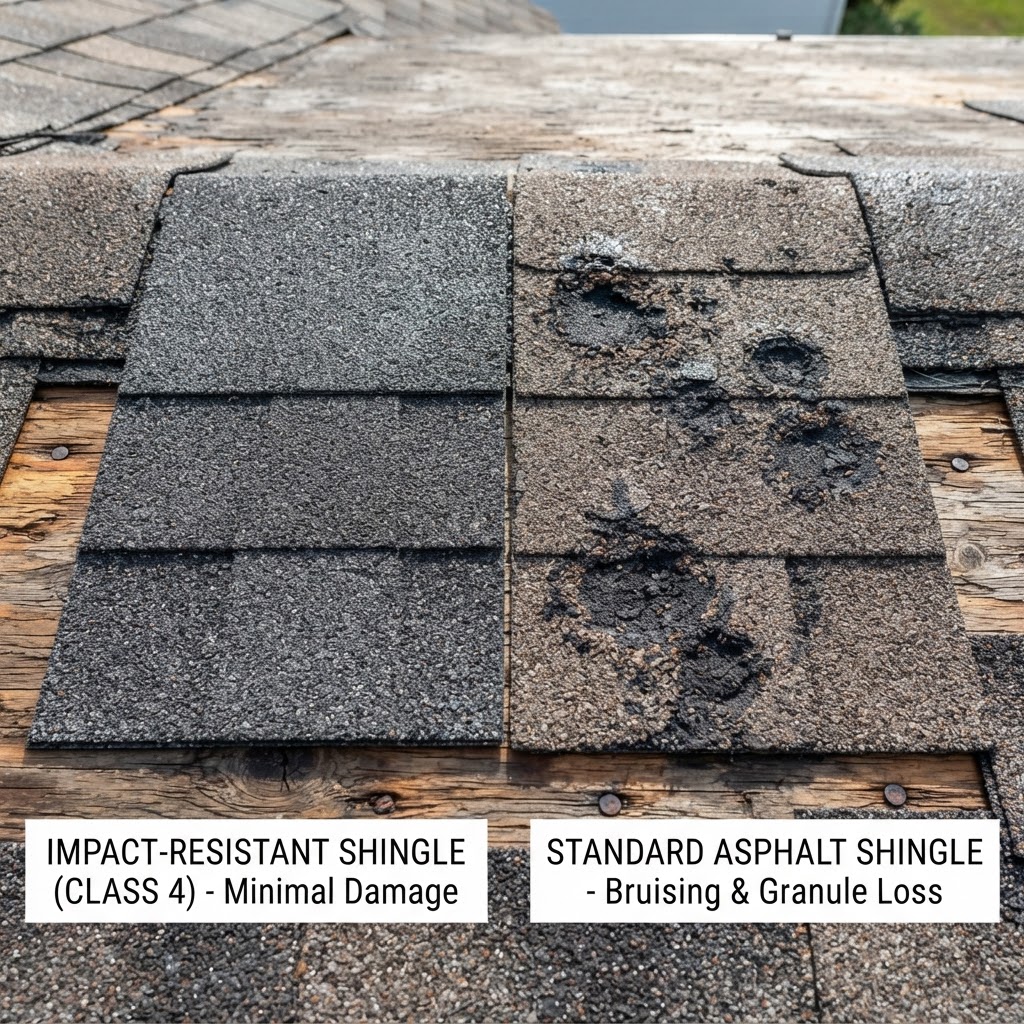
Impact-resistant shingle after hail, showing minimal damage.
Frequently Asked Questions
Related Pages
Written by Peter Regalado, Operations Manager · Reviewed by Mason Pastorello, Managing Director · Last reviewed: July 2026
- Licensed & insured — documentation available on request
- Free, documented roof inspections
- Real emergency service available
- 5-year workmanship warranty (manufacturer warranties vary by product)
- 30 years of construction experience
- Serving Denver, Adams, Arapahoe, Douglas, Jefferson, and El Paso counties
Promise Keepers Restoration
9615 E. County Line Rd, Ste. B-477, Centennial, CO 80112
Hours: Mon–Sat 8:00 AM–5:00 PM