Written by Peter Regalado, Operations Manager · Reviewed by Mason Pastorello, Managing Director · Last reviewed: July 2026
Before hiring a roofer, ask them a focused set of questions: Are you licensed and insured, and can I see documentation? Are you local with a real address, and how long have you worked here? What does your written scope include? How do you handle decking damage found during the work? What does your workmanship warranty cover, and for how long? And can you show me the evidence for your recommendation? The answers to these questions — and how readily and clearly a roofer answers them — tell you whether you're dealing with a professional you can trust. This article walks through the key questions to ask a roofer and what good answers look like, so you can evaluate a contractor with confidence.
Why asking the right questions matters
Hiring a roofer is a significant decision, and the questions you ask are your best tool for evaluating one before committing. A good contractor welcomes these questions and answers them clearly and directly; a contractor who is evasive, dismissive, or vague in response to reasonable questions is telling you something. The questions below cover the essentials — credentials, scope, warranty, and honesty — and together they give you a well-rounded picture of who you're considering. Just as important as the specific answers is how a roofer responds: clear, confident, documented answers signal professionalism, while dodging or pressure signals the opposite.
Are you licensed and insured, and can I see documentation?
This is the foundational question. A roofer should be licensed as applicable for your locality (Colorado handles roofing licensing at the local level) and should carry both liability insurance and workers' compensation. The key follow-up is "can I see documentation" — a legitimate contractor readily provides proof, while a hesitant or evasive answer is a serious warning sign. Why it matters: if a contractor isn't properly insured and a worker is injured or your property is damaged, you could be exposed, and if they're not properly licensed, the work may not meet requirements. A good answer is a straightforward yes with documentation provided. We're licensed and insured and provide documentation on request.
Are you local with a real address, and how long have you worked here?
This question addresses the storm-chaser problem directly. You want a roofer who is genuinely local, with a real physical address and a track record in the area, not a transient crew that will leave after the season. Ask how long they've worked in the community and whether they have a real local presence. Why it matters: if a problem develops or you need your warranty, a local established company is there to help, while a transient operator is gone. A good answer demonstrates a real local address, genuine time in the community, and a track record you can verify. A vague answer about being from out of the area or working out of a truck after a storm is a warning sign. We're an established local company serving the Front Range with a real address.
What does your written scope include?
A roofer should provide a detailed written scope, not just a bottom-line price, and you should ask what it includes. The scope should specify the materials, the tear-off approach, how decking is handled, the underlayment and flashing, the ventilation work, and the cleanup — detailed enough that you know exactly what you're buying. Why it matters: a detailed scope lets you compare bids fairly and know what you're getting, while a vague lump-sum number leaves you exposed to corners being cut. A good answer is a willingness to provide a detailed written scope and to explain what's included. Reluctance to put the scope in writing is a warning sign. We provide detailed written scopes.
How do you handle decking damage found during the work?
This is a smart, specific question that reveals professionalism. Since hidden decking damage can't be fully known until the old roof is removed, a good contractor has a clear approach — an allowance or a stated unit price for replacing damaged decking, so it's addressed transparently rather than becoming a surprise charge or being ignored. Why it matters: decking is the wild card of a roof replacement, and how a contractor handles it affects both your cost and the quality of the finished roof. A good answer explains their transparent approach to decking. A contractor who hasn't thought about it, or who seems likely to either ignore bad decking or surprise you with charges, is a concern.
What does your workmanship warranty cover, and for how long?
Ask specifically about the workmanship warranty, separate from any manufacturer material warranty. The workmanship warranty covers the contractor's installation, and you want to know what it covers and for how long, in writing. Why it matters: a workmanship warranty is only as good as the company backing it and its terms — which is another reason the local-versus-transient question matters, since a warranty from a company that's gone is worthless. A good answer is a clearly stated, documented workmanship warranty. We stand behind our work with a documented workmanship warranty.
Can you show me the evidence for your recommendation?
This question tests a contractor's honesty. Whatever the roofer recommends — repair, replacement, or nothing — ask them to show you the evidence: photos of the actual condition, an explanation of what they found, and why they're recommending what they are. Why it matters: a legitimate recommendation is backed by evidence you can see, while an assertion without evidence — especially a push toward the most expensive option, or a replacement recommendation from a door-knocker after a storm — should make you skeptical. A good answer is a contractor readily showing you documented evidence and explaining their reasoning. We show you what we find and explain our recommendation.
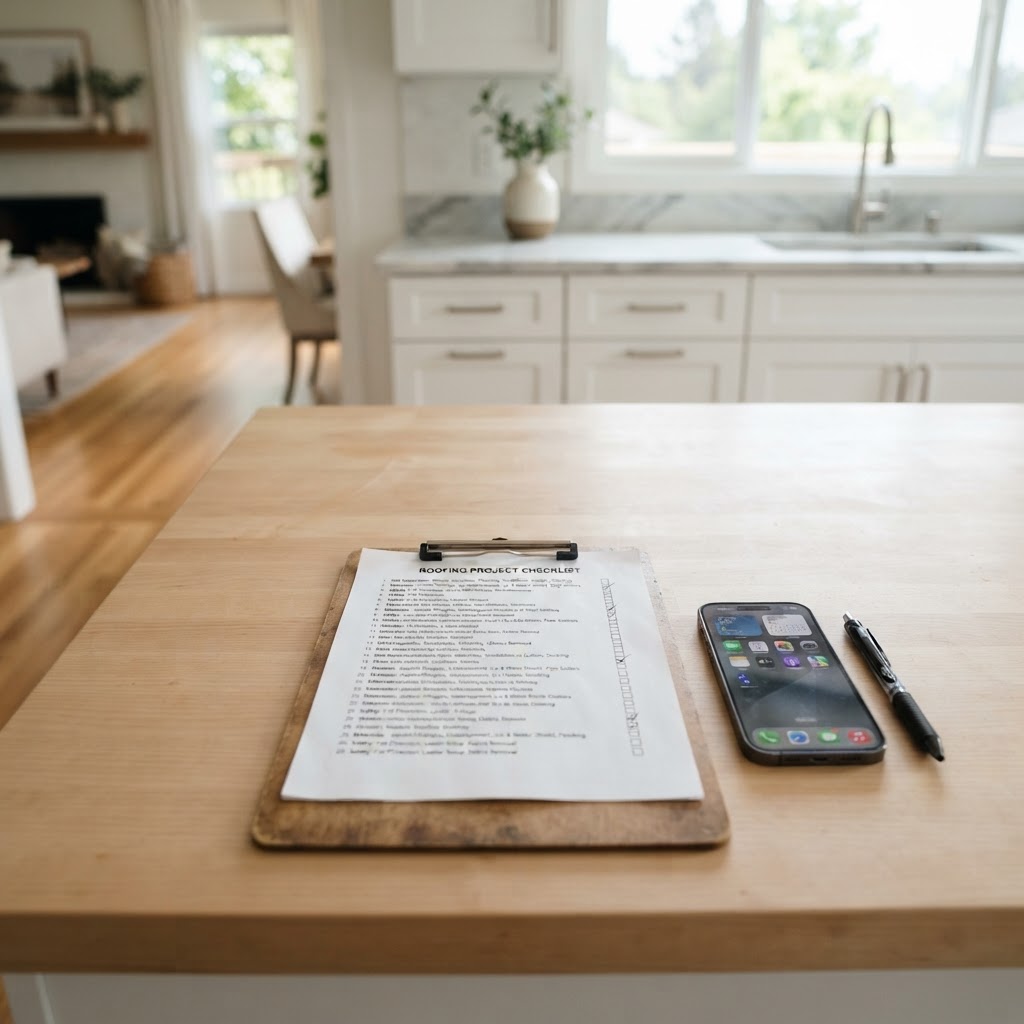
Homeowner using a checklist of questions when meeting a roofing contractor.
Frequently Asked Questions
- Licensed & insured — documentation available on request
- Free, documented roof inspections
- Real emergency service available
- 5-year workmanship warranty (manufacturer warranties vary by product)
- 30 years of construction experience
- Serving Denver, Adams, Arapahoe, Douglas, Jefferson, and El Paso counties
Promise Keepers Restoration
9615 E. County Line Rd, Ste. B-477, Centennial, CO 80112
Hours: Mon–Sat 8:00 AM–5:00 PM