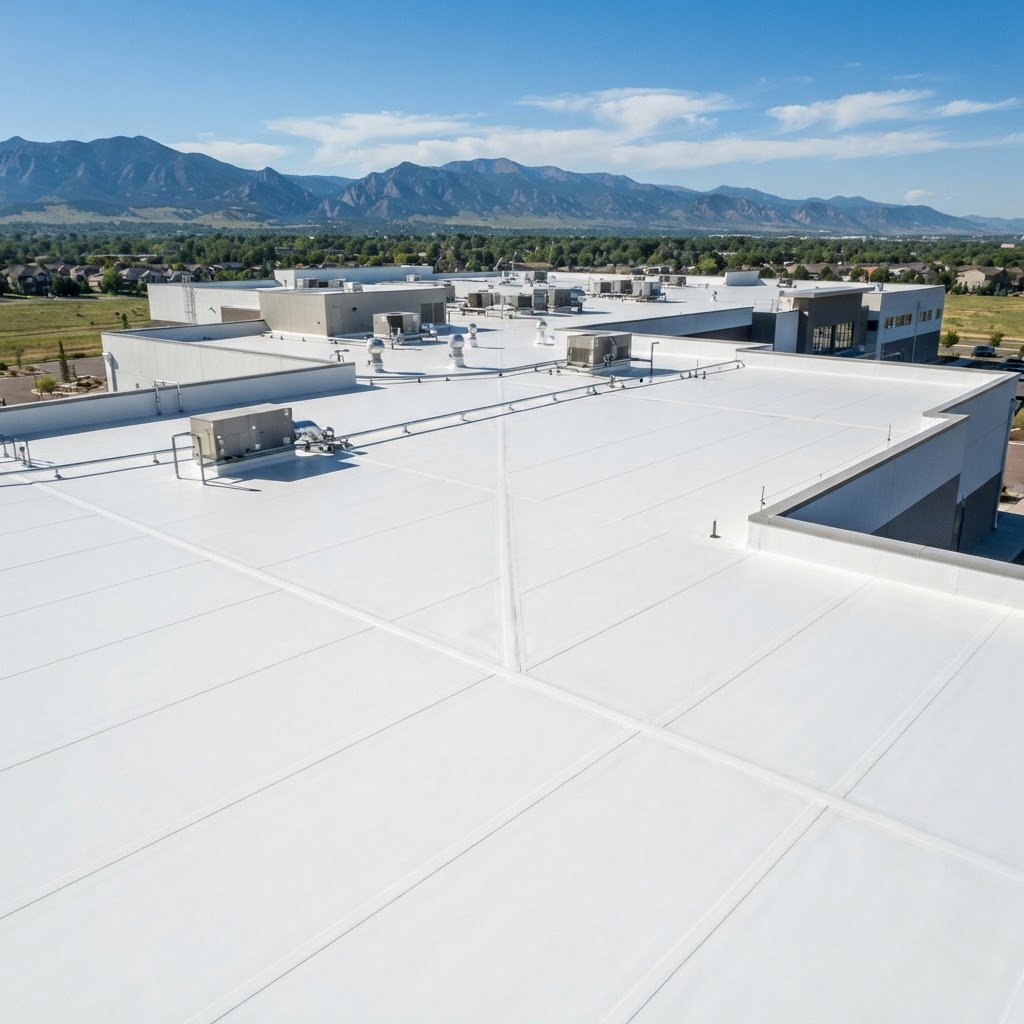
TPO roofing is one of the most common commercial flat-roof systems, and its reflective white surface and heat-welded seams make it a popular choice for many Colorado buildings. TPO — short for thermoplastic polyolefin — is a single-ply membrane that combines reasonable cost, energy-efficient reflectivity, and strong welded seams. This page explains what TPO roofing is, its strengths and tradeoffs, how it compares to other commercial systems, and how we approach TPO installation and repair for building owners and property managers across the Front Range. As with all commercial systems, we install TPO including Mule-Hide products and help you decide whether it's the right fit for your building rather than assuming it is.
What TPO roofing is
TPO is a single-ply thermoplastic membrane installed over a commercial flat or low-slope roof. It comes in large sheets that are rolled out over the roof, and its defining feature is that the seams where sheets meet are heat-welded, creating a bond that fuses the sheets together. This welded seam is one of TPO's main strengths — a properly welded seam is strong and watertight. TPO is most recognizable for its reflective white surface, though it comes in other colors, and that reflectivity is part of its appeal. It's a relative newcomer compared to systems like EPDM, but it has become one of the dominant commercial roofing membranes.
The reflectivity advantage
One of TPO's biggest selling points is its reflective surface. The white membrane reflects sunlight rather than absorbing it, which can reduce the heat that reaches the building and lower cooling loads in summer. For a Colorado building dealing with intense high-altitude sun, this reflectivity can translate into energy savings and a cooler building during the warm months. This makes TPO a member of the "cool roof" category and a consideration for building owners focused on energy efficiency. The actual savings depend on your building, its insulation, and its cooling system, so it's worth evaluating for your specific situation — but the reflective advantage is real, and a genuine reason TPO is popular.
The Welded Seam Strength of TPO Roofing in Colorado
TPO's heat-welded seams are a structural advantage. Rather than relying on adhesives or tapes that can degrade, the seams are welded with hot air, fusing the membrane sheets into what is effectively a continuous surface at the seams. A properly welded TPO seam is strong and watertight and resists the seam failures that can affect other systems. This makes seam quality on a TPO roof heavily dependent on installation quality — good welding produces durable seams, while poor welding undermines the system's main strength. This is why proper installation matters so much with TPO: the welded seams are only as good as the workmanship that creates them.
TPO strengths and tradeoffs
On the strength side, its reflectivity offers energy benefits, its welded seams are strong, its relatively light weight and reasonable cost make it accessible, and it's widely used with a strong track record for many buildings. On the tradeoff side, TPO as a product category has evolved over the years, and quality varies by manufacturer and formulation, making product choice important. Its long-term performance depends heavily on installation quality, particularly the seam welding. And like any single-ply membrane, it can be punctured. Understanding these tradeoffs helps you decide whether TPO fits your building and reinforces why choosing a quality product and proper installation matters.
How TPO compares to EPDM and PVC
Versus EPDM, the durable rubber membrane, TPO offers reflectivity that standard dark EPDM doesn't, while EPDM has a longer proven track record and is valued for its resilience — the choice often comes down to energy priorities versus long proven performance. Versus PVC, TPO is typically more economical, while PVC offers superior chemical resistance, making PVC preferable for buildings like restaurants with grease exposure. Each system has its place, and the right choice depends on your building. We help you weigh TPO against the alternatives for your specific situation rather than assuming TPO is automatically right because it's popular.
TPO installation and repair
Proper TPO work matters at both installation and repair. At installation, the membrane must be correctly laid and, critically, the seams properly heat-welded, since those welds are the system's strength; the many details around penetrations, edges, and flashing also need proper attention. At repair, TPO seams can be re-welded and punctures or damage patched to restore the membrane. Because TPO's performance depends so heavily on the quality of the welded seams and details, experienced installation and repair matter. We install and repair TPO systems including Mule-Hide products with attention to the seam quality and details that make a TPO roof perform.
Colorado considerations for TPO
The intense high-altitude UV makes TPO's reflectivity valuable for reducing cooling loads, but also means UV resistance and quality matter for the membrane's longevity. Hail can damage TPO as it can any membrane, so a TPO roof needs post-storm assessment. Freeze-thaw and temperature swings stress any membrane and its seams, making installation quality important. And proper drainage matters, since ponding stresses the roof. For a Colorado building, TPO's reflectivity is a real advantage, while the climate reinforces the importance of quality product and installation.
What building types suit TPO
TPO works well for a broad range of commercial buildings, which is part of why it's so widely used. Office buildings, retail properties, warehouses, and many other commercial structures with flat or low-slope roofs are common TPO applications. It's particularly attractive for building owners who want the energy benefit of a reflective roof or who are working within a reasonable budget. Buildings with significant chemical or grease exposure, such as restaurants, may be better served by PVC, and buildings where owners prioritize a long proven track record might consider EPDM — but for the large middle ground of ordinary commercial buildings, TPO is frequently a sensible fit. We help you determine whether your particular building falls into that fit or whether another system serves you better, which depends on your roof's characteristics, your building's use, and your priorities.
The importance of product quality with TPO
One point worth emphasizing about TPO is that not all TPO is equal. Because the product category has developed over the years and includes a range of manufacturers and formulations, the specific product you choose matters for long-term performance. A quality TPO product from a reputable manufacturer, properly installed, performs well, while a cut-rate product or poor installation undermines the system. This is part of why we work with quality systems including Mule-Hide products rather than treating all TPO as interchangeable. When you're evaluating a TPO roof, it's worth asking about the specific product, not just the system type, and working with an installer who uses quality materials and installs them properly. The value of a TPO roof comes from the combination of a good product and good workmanship, not from the membrane type alone.
Key Takeaways: TPO Roofing in Colorado
TPO is a popular single-ply commercial membrane known for its reflective surface and heat-welded seams. Its reflectivity can reduce cooling loads, a real advantage under Colorado's intense sun. Its welded seams are strong, but performance depends heavily on installation quality. TPO compares to EPDM (offering reflectivity versus proven longevity) and to PVC (being more economical versus PVC's chemical resistance). We install and repair quality TPO systems including Mule-Hide and help you decide whether it fits your building.
Reflective white TPO membrane roof with heat-welded seams on a Colorado commercial building.
Frequently Asked Questions
Related Pages
Written by Peter Regalado, Operations Manager · Reviewed by Mason Pastorello, Managing Director · Last reviewed: July 2026
- Licensed & insured — documentation available on request
- Free, documented roof inspections
- Real emergency service available
- 5-year workmanship warranty (manufacturer warranties vary by product)
- 30 years of construction experience
- Serving Denver, Adams, Arapahoe, Douglas, Jefferson, and El Paso counties
Promise Keepers Restoration
9615 E. County Line Rd, Ste. B-477, Centennial, CO 80112
Hours: Mon–Sat 8:00 AM–5:00 PM