Written by Peter Regalado, Operations Manager · Reviewed by Mason Pastorello, Managing Director · Last reviewed: July 2026
Flat roof drainage problems and ponding water occur when water fails to drain properly off a low-slope roof and stands on the surface, stressing the membrane, accelerating deterioration, and threatening the building — and because a flat roof depends entirely on proper drainage, these problems are among the most common and consequential a commercial roof faces. Ponding water is often called a flat roof's enemy, and understanding why drainage problems happen, the damage they cause, and how they're addressed helps building owners and property managers protect their roofs. This article explains flat roof drainage problems and ponding water, their causes, consequences, and solutions.
Why drainage is critical on a flat roof
To understand drainage problems, it helps to understand why drainage is so critical on a flat roof. Unlike a steep pitched roof that sheds water quickly by gravity, a flat or low-slope roof holds water longer and depends on proper drainage to move water off the surface. A flat roof isn't truly flat — it has a slight slope engineered to move water toward drains — and it relies on functioning drains, scuppers, and adequate slope to shed water. When this drainage works, water moves off the roof before it can cause harm. When drainage fails, water stands on the roof, and standing water is a flat roof's enemy.
What ponding water is
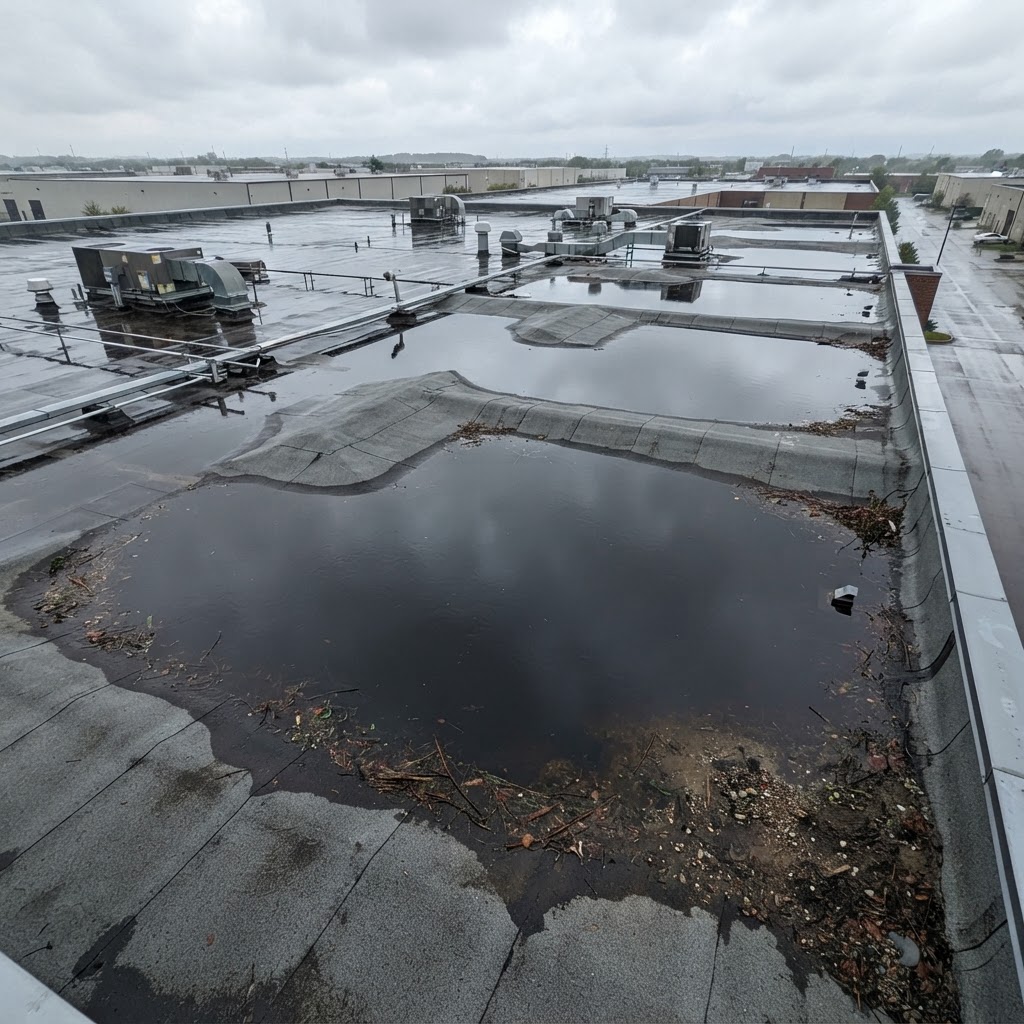
Ponding water is water that stands on a flat roof rather than draining off, typically defined as water that remains after a reasonable period following rain. Rather than draining to and through the roof's drainage system, the water pools in low areas or where drainage is inadequate and sits on the membrane.
Why ponding water is harmful
Ponding water is harmful to a flat roof in several ways:
- It stresses the membrane: Constant presence of standing water can accelerate deterioration.
- It adds weight: Standing water is heavy and adds load to the roof structure.
- It accelerates aging: Prolonged water exposure ages the membrane faster.
- It worsens with freeze-thaw: In climates like Colorado, cycles of freezing and thawing worsen the damage.
Common causes of drainage problems
- Clogged drains
- Inadequate slope
- Low spots
- Inadequate or poorly placed drainage
Addressing clogged drains
The most common and often most addressable drainage problem is clogged drains. Clearing drains, scuppers, and gutters is the first line of defense.
Addressing slope and low spots
More involved drainage problems involve inadequate slope or low spots, which may require adding slope, installing additional drainage, or potentially roof replacement.
The role of maintenance in preventing drainage problems
Regular maintenance and inspection are critical to catch drainage issues before they result in extensive damage.
How ponding relates to the roof's overall condition
Ponding is both a cause of deterioration and sometimes a symptom of an aging or settling roof.
The importance of addressing ponding promptly
Addressing ponding early limits the damage and protects the integrity of the roof membrane.
Ponding water standing on a flat commercial roof, indicating a drainage problem.
Frequently Asked Questions
- Licensed & insured — documentation available on request
- Free, documented roof inspections
- Real emergency service available
- 5-year workmanship warranty (manufacturer warranties vary by product)
- 30 years of construction experience
- Serving Denver, Adams, Arapahoe, Douglas, Jefferson, and El Paso counties
Promise Keepers Restoration
9615 E. County Line Rd, Ste. B-477, Centennial, CO 80112
Hours: Mon–Sat 8:00 AM–5:00 PM