Colorado's Front Range gets strong, gusty winds — downslope Chinook events off the foothills, spring gales, and severe-storm outflow — and roofs take the brunt. Wind damage is often subtler than hail: a shingle can be lifted, its seal broken, and set back down looking perfectly normal, while it's now free to flap, crease, and eventually blow off in the next gust. The shingles you find in your yard are only the part of the damage you can see.
We inspect, document, and repair wind-damaged roofs for homeowners across the Denver metro, Douglas County, the foothills, and the Colorado Springs area. Every inspection is free and documented, so you know exactly what the wind did — not just what's visible from the ground.
How wind damages a roof
Where hail attacks the surface of a shingle, wind attacks its edges and seals. Asphalt shingles are held down partly by nails and partly by an adhesive strip that bonds each shingle to the one below it. Wind finds the perimeter of the roof, the ridge, and any shingle that's already slightly loose, works underneath, and breaks that adhesive bond.
Once the seal is broken, two things happen. First, the shingle can lift and flap in future wind, working itself looser until it tears free. Second — and this is the part homeowners miss — water can now get under the shingle even if nothing is visibly missing. A roof can look completely intact from the driveway and already be compromised.
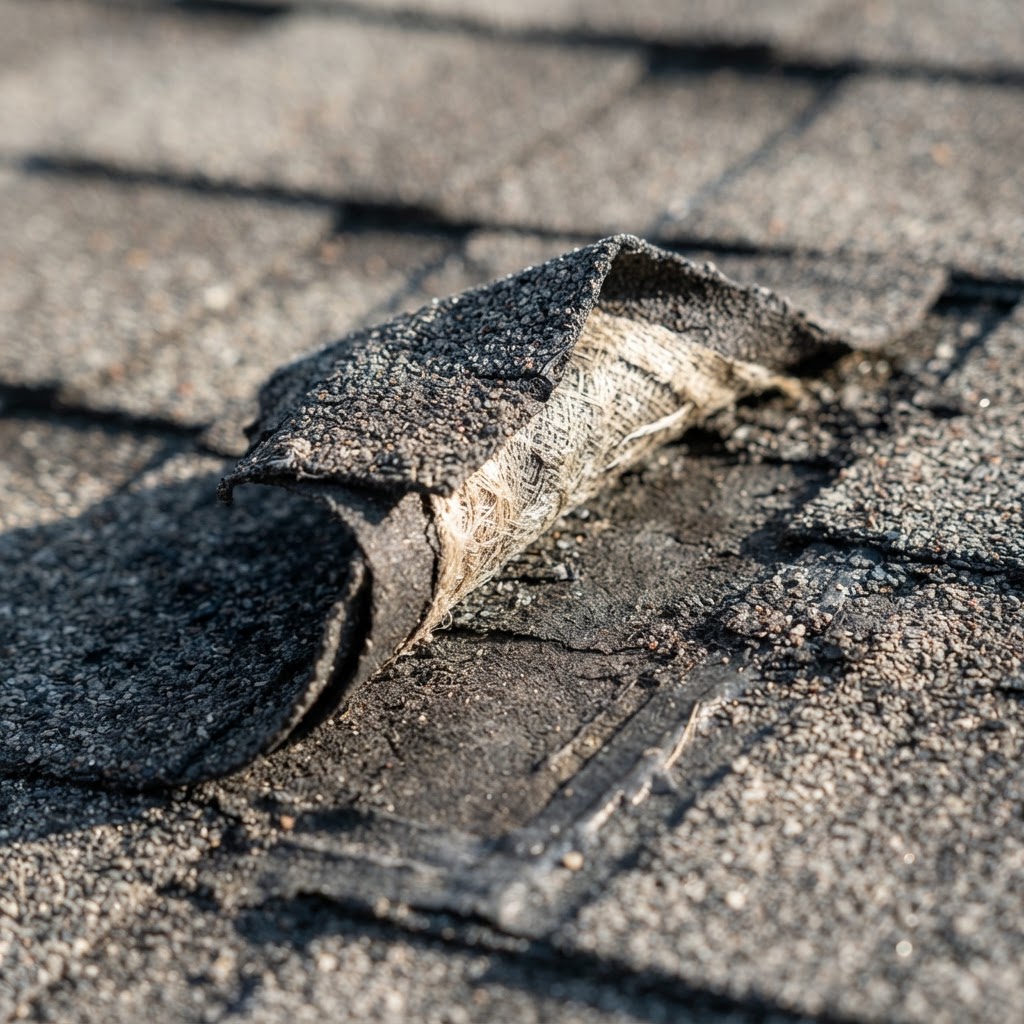
Creasing makes it worse. When wind folds a shingle back and it snaps down again, the fiberglass mat fractures along the crease line. A creased shingle won't reseal and won't perform, even though it's still physically on the roof. This is why an experienced inspection matters: the damage that leads to next year's leak often looks like nothing at all today.
The signs of wind damage
Some are visible from the ground; the important ones usually aren't:
- Missing or displaced shingles, often along edges, ridges, and corners where wind uplift is strongest.
- Lifted or curled shingles that no longer sit flat.
- Creased shingles — a horizontal fold line where the mat has fractured.
- Broken seals — shingles that lift easily by hand because the adhesive bond is gone (checked during inspection, not from the ground).
- Exposed or backed-out nails.
- Damaged or detached flashing and ridge caps, common wind casualties.
- Debris impact from branches or wind-thrown objects.
- New interior leaks or stains after a windstorm.
Our free, documented wind inspection
A wind inspection looks for what a ground-level glance can't see. On the roof where it's safe, we check the seals and edges for broken bonds, look for creasing that hides in plain sight, inspect the ridge, flashing, and penetrations, and photograph everything. That documentation shows you the real condition of the roof and, if a claim is involved, gives your insurer a factual record.
As with any storm damage, our role is clear: we inspect, document, and provide our scope. We don't decide your claim or promise a carrier will approve it — that's your insurer's decision under your policy.
Repair or replace after wind?
Wind damage is usually more localized than widespread hail damage, so a repair is more often the right answer — but not always. Here's how it tends to break down:
| Situation | Likely path |
|---|---|
| A section of lifted or missing shingles, roof otherwise sound | Targeted repair |
| Scattered broken seals across an aging roof | Repair or replacement, depending on extent |
| Widespread seal failure on an older, brittle roof | Replacement |
| Damage combined with existing hail bruising | Assessed together; often replacement |
Matching matters on wind repairs. Replacing a few shingles means matching color and profile as closely as your existing roof allows, and we'll be upfront when an older or discontinued shingle can't be matched perfectly. Creased shingles always get replaced, never reused — they won't reseal.
Colorado wind context
Wind exposure isn't uniform across the Front Range. Communities near the foothills and in open, unsheltered areas see stronger and more frequent wind loading, and downslope windstorms coming off the mountains can be severe. Older roofs and those with improperly sealed or under-nailed shingles are the first to lose shingles in these events. (Specific wind-event dates and speeds vary and should be confirmed via National Weather Service records — we don't reference storms we haven't verified, and neither should a contractor quoting you.)
What makes a roof more or less wind-resistant
Not all roofs stand up to wind equally, and the difference usually comes down to a few factors you can control on your next roof:
- Shingle wind rating. Shingles carry manufacturer wind ratings, and higher-rated products hold up better in the gusty conditions common along the Front Range.
- Nailing. The number and placement of nails per shingle matters enormously. Under-nailing, or nails driven in the wrong spot, is one of the most common reasons shingles blow off — and it's a corner storm-chasing crews often cut.
- Sealing conditions at install. Shingle adhesive strips need warmth to bond. Roofs installed in cold weather may never seal fully, leaving them vulnerable until the next warm spell — if ever. A quality installer accounts for this.
- Edge and ridge detailing. The perimeter and ridge take the most uplift, so proper starter strips, reinforced edges, and correctly installed ridge caps make a real difference.
- Roof age and condition. Older shingles are brittle and their seals weaken over time, so an aging roof is simply more likely to lose shingles than a newer one in the same wind.
When we replace a roof, we install it to resist the conditions it will actually face — which on the Front Range means treating wind as seriously as hail. If your current roof keeps losing shingles in ordinary windstorms, the underlying issue is often one of these installation factors, and it's worth having inspected.
Wind versus hail — why the difference matters
Homeowners often lump all storm damage together, but wind and hail leave different signatures and sometimes lead to different outcomes with insurers. Hail bruises the shingle surface across broad areas; wind breaks seals and lifts shingles, often more locally. A single storm can bring both, which is why our inspection looks for each pattern separately. If you're not sure which you're dealing with, that's fine — the inspection sorts it out.
What not to do after a windstorm
- Don't assume the roof is fine because no shingles are missing. Broken seals don't show from the ground and are the most common wind damage.
- Don't leave creased shingles in place. They won't reseal and will fail in the next gust.
- Don't ignore lifted ridge caps and flashing — common wind casualties that lead to leaks.
- Don't let anyone reuse creased shingles on a repair.
- Don't wait for a leak to appear — by the time water shows inside, the damage has usually spread.
Our wind damage process
If you've had a windstorm, here's what working with us looks like. We schedule a free inspection and get on the roof where it's safe. We check seals and edges by hand, look for creasing, and inspect ridge, flashing, and penetrations — documenting everything with photos. We show you the findings and explain what's a simple repair versus a broader problem. We give you a straight recommendation, provide documentation and scope if a claim is warranted, and complete the repair or replacement using properly matched, correctly sealed and nailed shingles. The work is backed by our 5-year workmanship warranty.
Promise Keepers Restoration · 9615 E. County Line Rd, Ste. B-477, Centennial, CO 80112 · 720-650-1116 · Licensed & insured (documentation on request) · Free inspections · Emergency service available.
Wind-creased shingle with a broken seal on a Front Range roof
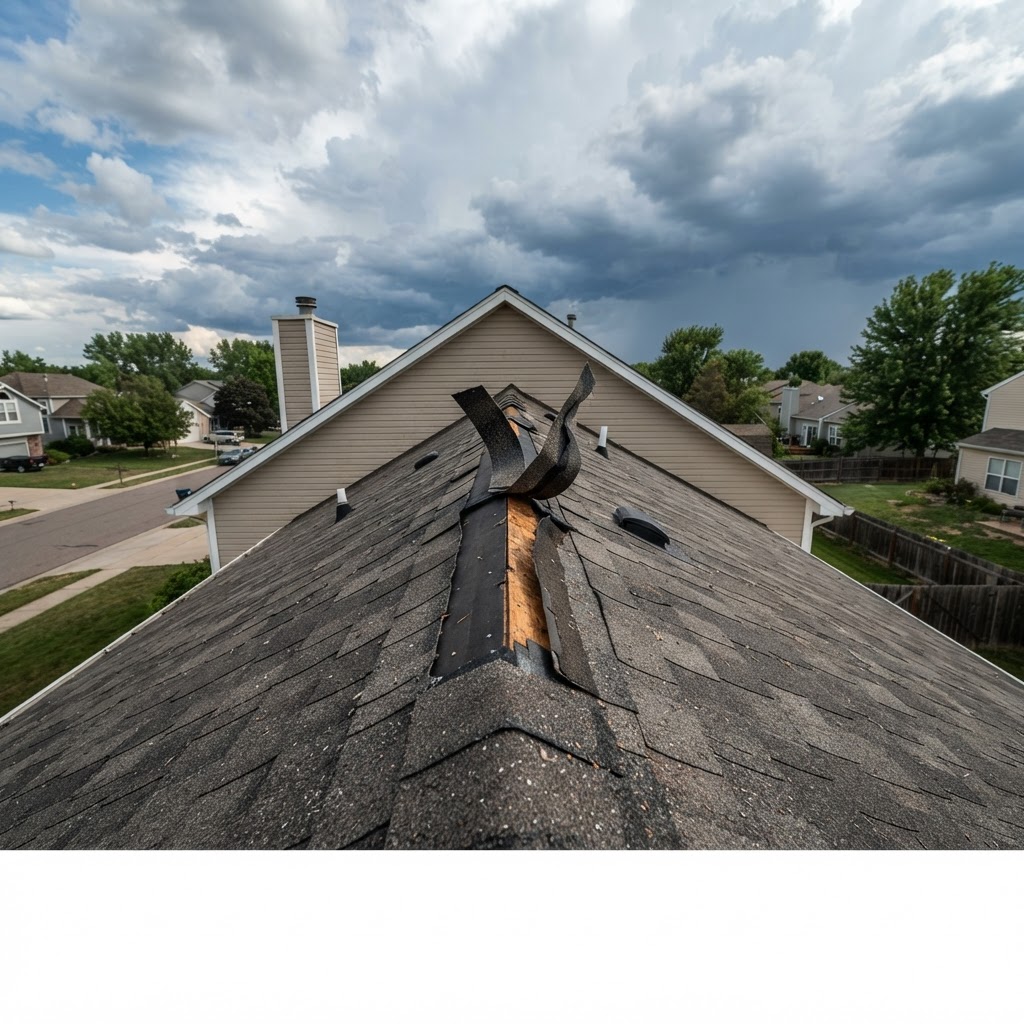
Missing shingles along the edge of a Colorado roof after a windstorm
Frequently Asked Questions
Written by Peter Regalado, Operations Manager · Reviewed by Mason Pastorello, Managing Director · Last reviewed: July 2026
- Licensed & insured — documentation available on request
- Free, documented roof inspections
- Real emergency service available
- 5-year workmanship warranty (manufacturer warranties vary by product)
- 30 years of construction experience
- Serving Denver, Adams, Arapahoe, Douglas, Jefferson, and El Paso counties
Promise Keepers Restoration
9615 E. County Line Rd, Ste. B-477, Centennial, CO 80112
Hours: Mon–Sat 8:00 AM–5:00 PM