Written by Peter Regalado, Operations Manager · Reviewed by Mason Pastorello, Managing Director · Last reviewed: July 2026
Signs your commercial roof needs replacement include widespread membrane deterioration or damage, recurring leaks despite repairs, ponding water that won't resolve, extensive seam or flashing failures, a roof at or past its expected service life, and a pattern of escalating repair needs. As with residential roofs, isolated issues may call for repair while widespread problems on an aging commercial roof point to replacement, and only an inspection can determine which. This article explains the signs that a commercial roof may need replacement, what they mean, and how to approach the replacement decision, so building owners and property managers can recognize when a commercial roof is reaching the end.
Why recognizing the signs matters
For a commercial building, recognizing when the roof needs replacement matters because a failing commercial roof that isn't addressed can lead to significant consequences: leaks that damage the building interior, inventory, and equipment; disruption to business operations; tenant issues; and escalating emergency repair costs.
Sign: widespread membrane deterioration or damage
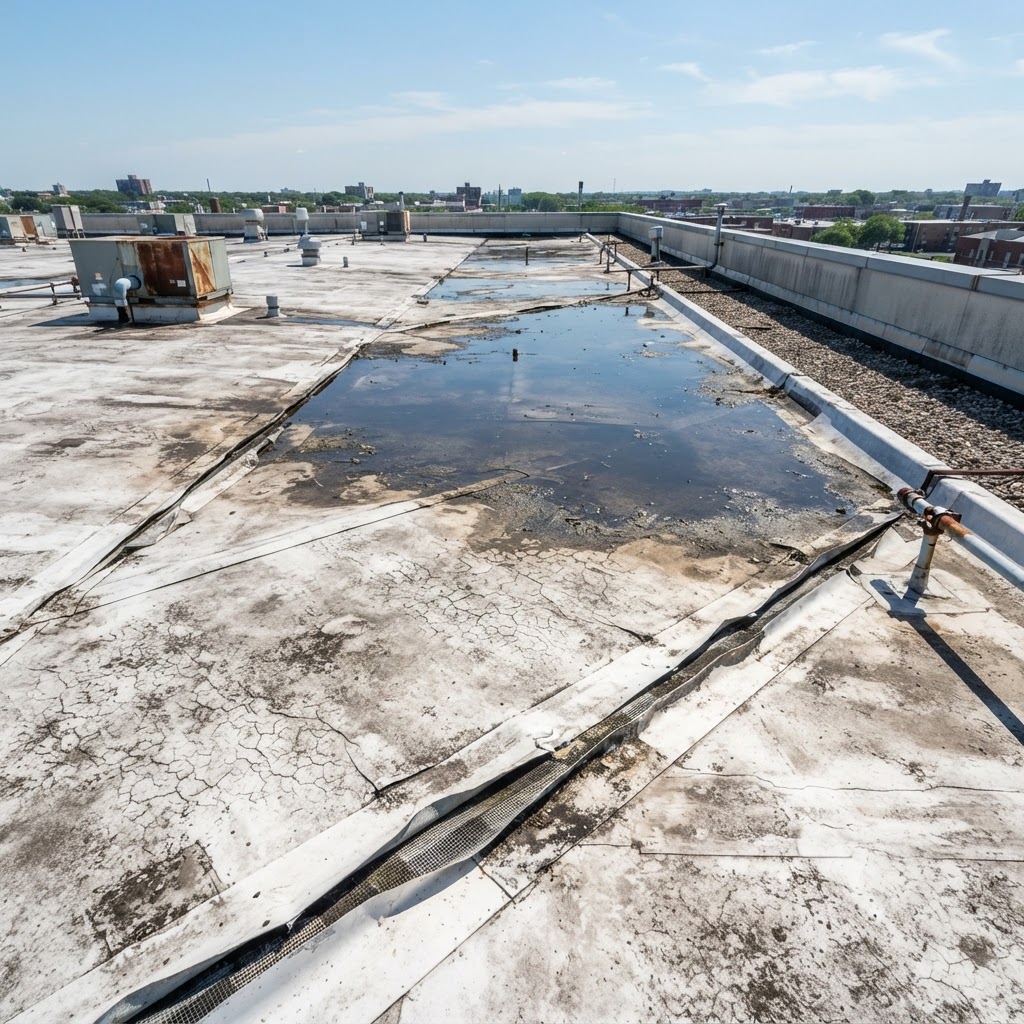
A key sign is widespread deterioration or damage across the roof membrane. When a commercial roof membrane shows widespread problems — extensive wear, deterioration, damage, or aging across the roof rather than isolated issues — it indicates the membrane itself is failing.
Sign: recurring leaks despite repairs
Recurring leaks that persist despite repairs are a significant sign. If a commercial roof develops leaks repeatedly, with new leaks appearing even as others are repaired, it suggests the roof is failing broadly rather than having isolated, fixable problems.
Sign: persistent ponding water
Persistent ponding water that won't resolve is a sign worth attention on a flat commercial roof. Ponding water accelerates membrane deterioration, and if a roof has developed drainage problems and ponding that can't be adequately corrected, it can be part of the case for replacement.
Sign: extensive seam or flashing failures
Extensive seam or flashing failures are a sign of a failing commercial roof. When these failures are widespread rather than isolated, they're part of the picture of a roof reaching the end.
Sign: age of the roof
The roof's age is a significant factor. Every commercial roofing system has an expected service life, and as a roof approaches or passes that age, the likelihood of needing replacement rises.
Sign: escalating repair needs
A pattern of escalating repair needs is a practical sign. At some point, the escalating cost and frequency of repairs exceeds the value of continuing to repair, and the money spent on repeated repairs could go toward the replacement the roof ultimately needs.
Telling replacement from repair
As with residential roofs, the key question these signs raise is whether the commercial roof needs replacement or repair, and the answer depends on how widespread and severe the problems are.
The value of planning a commercial roof replacement
A planned commercial roof replacement can be scheduled to minimize disruption to building operations, budgeted and financed appropriately, and managed as an orderly project.
Considering system choice at replacement
A commercial roof replacement is also an opportunity to reconsider the roofing system. You can choose the membrane system that best fits the building's current needs, which may be the same as the existing system or a different one.
Colorado Context: Signs Your Commercial Roof Needs Replacement
In Colorado, the frequent hail can damage commercial roofs and contribute to their decline. The intense UV ages membranes, while freeze-thaw and ponding concerns stress flat roofs.
Widespread membrane deterioration on an aging commercial roof nearing replacement.
Frequently Asked Questions
- Licensed & insured — documentation available on request
- Free, documented roof inspections
- Real emergency service available
- 5-year workmanship warranty (manufacturer warranties vary by product)
- 30 years of construction experience
- Serving Denver, Adams, Arapahoe, Douglas, Jefferson, and El Paso counties
Promise Keepers Restoration
9615 E. County Line Rd, Ste. B-477, Centennial, CO 80112
Hours: Mon–Sat 8:00 AM–5:00 PM